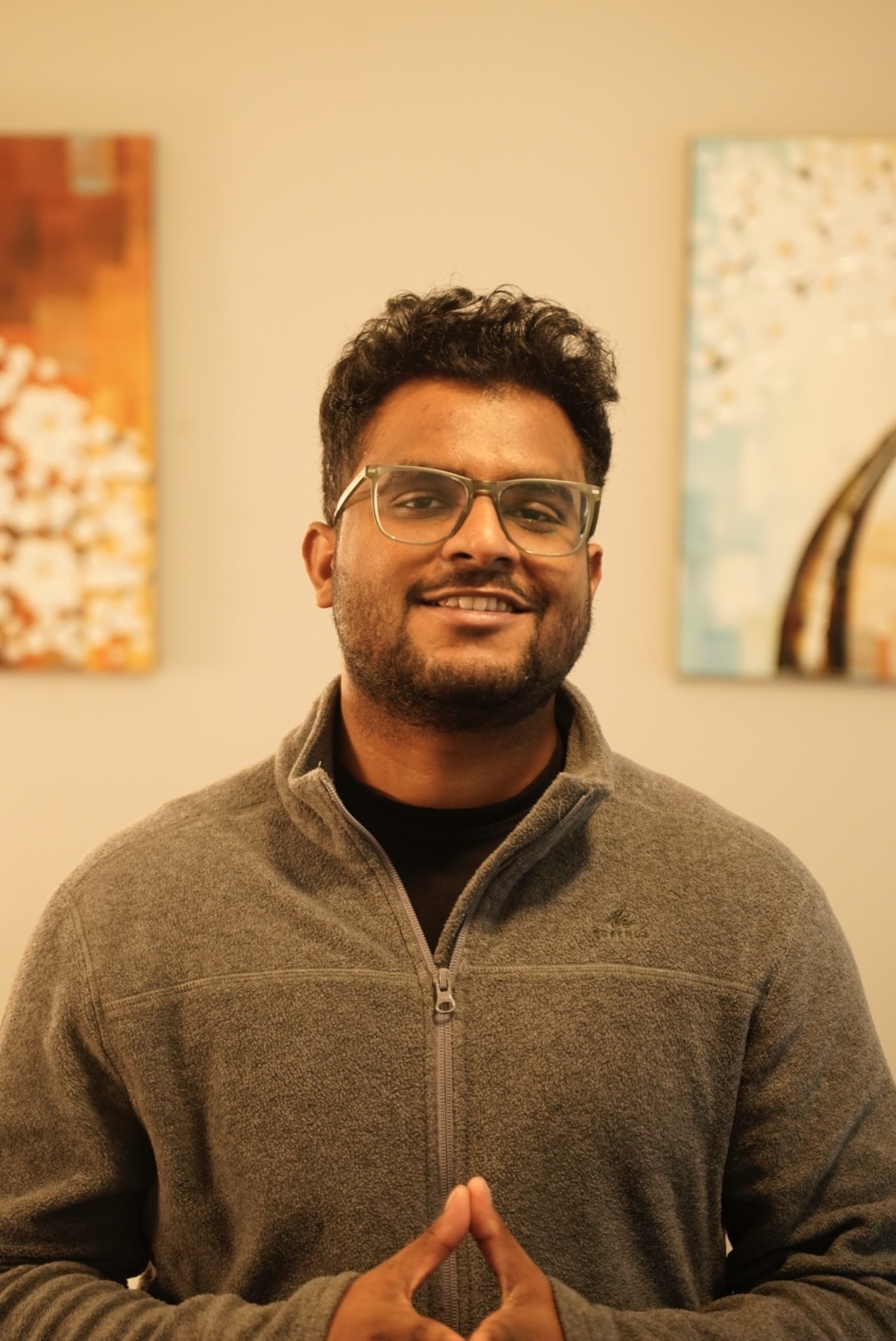
Yep! Thaat's me! 😁
All in all, I'm a blob-shaped Product Designer.
Based in Boston, MA.
Over the past 6 years, I’ve had the chance to work across MNCs, startups, and non-profits, taking on roles from UX designer and researcher to frontend developer, design lead, and consultant. Wearing many hats has helped me grow quickly, and I’m proud of how much I’ve learned in such a short time.
These days, I’m channeling that experience into designing and building a cool proactive desk robot—while keeping my eyes open for my next exciting design adventure.
lil' more about me
So you're a blob?
You’ve probably heard of T-shaped designers—those with a broad understanding of many things but deep expertise in one. And of course, there’s the old saying, “Jack-of-all-trades, master of none.” But neither really captured who I am. That’s when I came across blob-shaped designers.
Quoting Samantha Warren, Senior Design Director @ Adobe from this article, "Become blob-shaped". It’s all about adapting your skillset to meet the challenge at hand. And that’s me in a nutshell. I’m not confined to a single specialty—I shape-shift depending on what the project needs.
I also become something akin to a blob sometimes (Thank you, Boston winters!), but that's besides the point, as I was saying, it's always a great conversation starter!!
How did you get into design in the first place?
Design has always been in my life. Growing up, my mom was a graphic designer, and I spent hours with her learning the ropes, like swapping my cousin’s head with a monkey’s body in Photoshop. Then, there was my uncle, an industrial designer. He’d tell me stories about how his designs solved real-world problems, and that’s when I knew I wanted to do something similar. So, I went on to study industrial engineering.
In university, I joined a Formula Student team, which gave me a taste of applying design to real-world challenges. But as I got deeper into engineering, I realized I didn’t just want to build things—I wanted to create experiences. That’s when I found UI/UX design and eventually became a design consultant for Apple, which opened my eyes to the power of design at scale.
Being a blob-shaped designer, I’ve absorbed different skills along the way, like photography. I got good at it, and soon startups were coming to me for product photography and videography. From there, I worked with startups and NGOs, combining my UX skills with my new creative tools, and eventually became a lead designer at a startup.
Wanting to learn more and expand my horizons, I pursued a Master’s in HCI, where I connected with people from all over the world. And down the road, my goal is to teach design at scale in India—passing on what I’ve learned to the next generation of designers.
At the core, design for me isn’t just about aesthetics or business—it’s about people. It’s about understanding how they live, work, and think, and finding ways to make their lives a little easier.
What is your design process?
I approach design like I'm cooking an egg – and trust me, there are endless ways to crack this one. You could go scrambled, poached, hard-boiled, or whip up an omelette. Maybe you'll pivot entirely and transform that egg into a custardy french toast (plot twist!). Or perhaps you'll get carried away and create what I call the 'kitchen sink omelette' – you know, when your ambitious masterpiece turns into more of a "well, that's definitely food" situation.
But here's the real secret sauce: before I even crack that egg, I need to know who's going to eat it. Maybe your users are health-conscious folks who want their eggs whites-only with a sprinkle of herbs (minimal, clean design), or perhaps they're hungry construction workers craving a hefty breakfast burrito (robust, feature-rich interface). Through user research, I'm basically hanging out in the kitchen asking questions like "How do you like your eggs?" and "Remember that time you had a terrible runny egg? Let's talk about that trauma."
At the end of the day, what matters is twofold: is the person eating it happy (user needs served with a smile), and did we manage to make it without breaking the bank buying truffle oil and saffron (business needs met efficiently)? Sometimes the perfect solution is a simple sunny-side up, even though you know how to make a fancy frittata.
Because let's face it – you can master every egg technique in the world, but if you're serving an eggs Benedict to someone who just wanted scrambled eggs with toast, you've kind of missed the whole point. And nobody wants to be that chef.
What I am saying is, there’s no “one-size-fits-all” in design. I don't have a single ultimate design process. Every problem is unique, and the solution has to be just as tailored—taking into account, variables like user needs, business goals, timelines, resources, etc. Flexibility is key because, let’s face it, change is the only constant in design!
Saying all that, here's where it begins for me. I always start with the function, once we’ve nailed how it works, we can make it look awesome. My overall process can be broken down into four steps, but the real magic is staying open and ready to adapt as things evolve. Here’s how I I do it:
01. Understand & Be Adaptable
I kick things off by getting a deep understanding of the problem with strictly necessary user research and making sure everyone’s on the same page. But I stay flexible—because let’s be real, things change, and that’s okay! New insight? Change in scope? Unforeseen challenge? Have to pivot? Let's do it!
02. Prioritize & Ideate
Ideas are endless, it all comes down to brutal prioritization—focusing on the ideas that really make a difference for both users and the business. Then, it’s time for some brainstorming magic! I love bringing diverse perspectives together to generate ideas and refine them fast.
03. Prototype Fast & Manage Time Effectively
I break down projects into manageable sprints and make sure everyone’s got clear roles and deadlines. We move quickly—prototyping, testing, and adapting based on user feedback—while keeping things on track and on time.
04. Align & Keep Iterating
I keep stakeholders in the loop with regular, no-nonsense updates (no long-winded presentations here! Unless requested for). After launch, I dive into data and feedback to continuously fine-tune the design, making sure it’s a win for both users and the business.
05. Leave your mark (Bonus point)
I believe it’s crucial to have your own signature style and make your presence known—whether through leadership, productivity, visuals, or communication. I always make sure to leave my imprint on the work I do, and even when I move on, that presence lingers. It’s not just about getting the job done; it’s about leaving something behind that reflects who you are and how you approach the world.
This is me. This is my approach to design.
What tools do you use?
My toolbox includes Figma, Dovetail, Optimal Workshop, Adobe Suite, front-end development, Blender and various project management tools. Since my time of industrial engineering, 3D modeling and animation have been my one true love. Lately, I’ve been diving deep into the exciting realms of AI and Robotics—because who doesn’t love a bit of futuristic tech?